Sunday, February 23, 2014

Fifty Shades of Gray and Cross-country Skiing.


Good Glide
 
       Apparently, the Norwegians lost the cross-country skiing event in the Olympics because their official ski wax technician messed up. And I always thought winning had to do with the athletes! 
        Droves of Norwegians are demanding the technician's resignation. Apparently he didn't study the ski-waxing e-book called "Good Glide." In Norway, "Good Glide" has displaced "Fifty Shades of Gray" as the top best-seller.
     I'd like to offer an alternate explanation as to why the Norwegians lost the cross-country events: lack of passion. If a country prefers a technical manual to a hot sex novel, then surely they must lack passion. Notice how much passion the winners in all the events have! So my suggestion to the cross-country coaches in Norway: have your competitors read "Fifty Shades of Gray" and get a little passion in your skiing.

Friday, February 21, 2014

ON EDUCATION

"It is important that students bring a certain ragamuffin barefoot irreverence to their studies; they are not here to worship what is known , but to question it."
                                                                     Jacob Bronowski "The Ascent of Man"

"The important thing is not to stop questioning."
                                                                           Albert Einstein

Thursday, February 20, 2014

CREATIVITY MILKSHAKE


To get the brain going and the creative juices flowing:
Creativity Milkshake
 
 
1 cup milk
2 ripe bananas
1/2 cup peanut butter
1/4 cup chocolate syrup
1 pint vanilla-flavor Greek frozen yogurt
Whipped cream and a cherry for the top
 
 
Blend until blended!
Share, or drink the whole shebang yourself.

Monday, February 10, 2014

Turkey Disaster


Turkey Disaster
 
     My son and I lived in Aberdeen, Scotland for a year. Like the other Americans living there, we celebrated American holidays at the appropriate times. When Thanksgiving rolled around, I invited neighbors for a traditional holiday feast. I was quite busy during the week preceding Thanksgiving, so I neglected to buy the goodies until the last minute, paying no attention to my colleagues' talk about "ordering their turkeys." It seemed like a lot of bother to me: going to the store to order the turkey, and then going back to the store to pick it up.
     The day before Thanksgiving, I set out for the grocery store. There were no turkeys to be seen.
     "Where are the turkeys?" I asked.
     "Did you order one?" was the reply.
     "Why should I order one, don't you always have turkeys?"
     No, they did not. I spent the day making the rounds of the grocery stores in Aberdeen, always getting the same thing: "Why did you not order your turkey?"
     Finally, someone suggested I try the business that sold to restaurants. It was my last hope. I walked out with a forty-pound turkey, the smallest they had. That evening, after I had removed every item from the refrigerator to make room for the turkey, I calculated the time required to cook a forty-pound turkey.
     I set the alarm for three, hopped out of bed, prepared my giant turkey, but alas. The thing wouldn't fit in the oven. By shoving and squeezing, I finally managed to force it in, but the oven door wouldn't shut. I pushed a chair against the door to hold it in place, but there was a gap of three of four inches through which the heat escaped.
     Guests were invited for three. At seven we still waited for the turkey to finish cooking -- a thoroughly humiliating experience.
       There remained about five months worth of turkey leftovers and it took me at least five months to finish scraping the turkey from the sides of the oven.
     The next time I live in Scotland we're going out for Thanksgiving dinner and having haggis.

Sunday, February 9, 2014


If God Meant Woman to Cook

She wouldn’t have Invented Restaurants

 
            I have very few talents, and cooking definitely isn’t among them. Growing up, I learned to open a can, dump the contents into a pan, set the pan on the stove, and then turn on the eye. I learned to salt meat (heavily), coat it with flour, heat up the lard in the frying pan, and fry the meat. I didn’t know there was any other way to cook meat. Chicken, steaks, fish, pork chops all got the same treatment. Salt, coat, and fry. Better known as SCF cooking. It’s also known as Southern cooking.

 The only exception to the SCF method in the house where I grew up was turkey. My mother excused me from the preparation of the Thanksgiving meal (Company was coming so it needed to be edible!) hence its preparation remained something of a mystery. I knew it involved basting (I had no idea what that was), and brining (no idea about that either). When I married, I decided that if I’d learned to read (and I had), and if I’d learned what measuring spoons were (I’d learned that, too.), then I could cook a Thanksgiving turkey. I opened my Good Housekeeping Cook Book (a wedding present), turned to the turkey pages, and went from there. The turkey turned out fine, but I think its fineness had to do with my mother-in-law standing over me, explaining every step in the cookbook. Subsequent efforts in the kitchen weren't so successful.

            During my first year as a housewife, I decided it was my duty to prepare meals using something other than the SCF and open a can method. After studying the recipes in The Good Housekeeping Cook Book, I dog-eared the ones I thought I could handle, made grocery lists, and gave it the old college try. There were problems. The first arose when I didn’t know the difference between Worcestershire and Tabasco (How was I to know? They’re both the same color!). This made my first attempt at spaghetti . . . . well, interesting. The recipe called for Worcestershire. I liked to add a little extra of whatever I was using for good measure, just to make sure the taste got through. So I dumped goodly amounts of Tabasco into the spaghetti sauce. After that fiasco, I used the open a can approach for spaghetti sauce, or rather the open a jar approach. Even with my Good Housekeeping Cookbook, my successes in the kitchen were so few and far between, that I can’t actually remember any.

            Predictably, after marriage came children. Two of them. If the goodness of a mother is measured by the cookies she bakes for her children, then I was a bad mother. Except for a few occasions when I bought those rolls of pre-prepared cookie dough that you slice and pop into the oven, I didn’t do cookies. Not even Christmas cookies. Why bake cookies when everyone gives you little tins filled with their sparkly, iced, and spiced opuses shaped like trees, stars, and angels?  Besides, I hated the idea of scrubbing flour off the kitchen counter after baking. Not to mention the flour that coated the floor. And my hair. And the children’s hair.

The cookbook got lost in the shuffle of diapers, music lessons, soccer practice, chauffeuring, nagging about homework, laundry, et cetera. I got over feeling guilty about using the open a can and SCF technique. I believe I actually did my daughter-in-law a favor by being a bad cook. She will never have to hear my son say: “If you could only cook like my mother.”  Just in case she might actually threaten to cook like his mother, he learned to cook himself. Quite well, I have to say. As did my daughter. Being a terrible cook does have its advantages. When I visit them I sit with my gin-and-tonic while they cook delicious meals for me.

            Eventually, I wound up in the place most women do: widowed with married children thoughtless enough to go off and do their own thing. They say make lemonade when life gives you lemons. I have no idea how to make lemonade other than it involves a lot of lemon squeezing and sugar, but I decided my lemonade would be never cooking again. Isn’t that what restaurants are for? I reasoned that had God meant me to cook she would have given me a talent for cooking, but instead she invented restaurants. Behold the goodness of creation!

And so I’ve devoted the past few years to having someone else do the cooking.  Sometimes, though, it doesn’t quite work out the way you intended. Adventures happen, mishaps occur, the unexpected pops up, and sometimes everything that can possibly go wrong, goes wrong. Especially when you’re eating in a far corner of the world. I have scribbled down a few of these adventures and, over the next few weeks, will share.  


Friday, January 31, 2014

Living Abroad in the Middle East


Oman
 
       Living abroad is full of opportunities and surprises. For one thing, I traveled places I'd never have gone otherwise. In fact, I'd probably never have gone to the Middle East at all, had I not lived and taught in Qatar of eight years. Since the UAE, Jordan, Lebanon, Oman were all nearby, I visited each of these Middle Eastern countries (I went to Jordan twice, and would love to go again!).

      Oman is a lovely country to visit. Like the other Middle Eastern countries, Oman is Muslim. It seems to be a "softer" culture, however. Or appears to the outsider to be. For one thing, the Omani men wear different colors as opposed to the Qatari and Saudi men who wear stark white.
     My friend and I spent time in Muscat and then traveled to Salalah in the south. While shopping in a tiny village there, two children followed me from shop to shop, staring at my white hair and light skin. I felt like a spectacle! I guess I was to them.
     The above picture was taken while we traveled around the desert in an SUV. We'd stopped, and were walking around, enjoying bare feet in the sand when a group of Bedouins passed.

Thursday, January 30, 2014

C.S. Lewis

       In my late twenties and early thirties, I was a big fan of C.S. Lewis, reading everything he wrote, some of it twice. I also read everything about C.S. Lewis that I could get my hands on. It has been a long time since my twenties, but recently I was happy to see another book about him published.
       Devin Brown, a Lilly scholar and professor of English at Asbury University, has written, taught, and lectured on C.S. Lewis extensively for more than ten years and has authored a number of books related to both Lewis and Tolkien. His most recent, A Life Observed, A Spriritual Biography, contains a foreword by Douglas Gresham, Lewis's step son. Brown claims that the goal of his book was to focus closely on the story of Lewis's spiritual journey and his search for the object of the mysterious longing he called Joy, a quest which he claimed was the central story of his life.
      I went to Asbury University for the "kick-off" of the book. Douglas Gresham flew in from England to participate. I was surprised at the number of people who turned up in the Asbury auditorium to listen to Brown and Gresham, and I'm sure that the program ended much too soon for anyone who has ever been a C.S. Lewis fan. From start to finish, my attention was riveted to Gresham's anecdotes about his stepfather.
      C.S. Lewis and Tolkien were friends, both teaching at Oxford. While the movies based on Tolkien's books, The Ring series and The Hobbit have been lauded by many, I didn't like them. It seems to me that the movies didn't pick up so much of what was in Tolkien's books. The books based on C.S. Lewis's Narnia series, however, have translated wonderfully into movies.  
     The popularity of C.S. Lewis is something of a phenomenon. In so far as I know, there has never been a big publicity campaign upon publication, no talk shows, no big advertisements in magazines. So how did it happen? Has it all been word-of-mouth?


Saturday, January 18, 2014

No Toilet Paper in the Desert?


                             Qatari Boys                                                   American Girl Enjoying the Desert


Middle Eastern Etiquette
       
               Aware that I was about to be living in a culture far different from the one I'd grown up in, I did what I could to learn about the "do's" and "don'ts" of living in a Muslim society before I went. The Qataris are Sunni, and part of the conservative Wahabi sect, as are the Saudis. The great wealth of the Qataris has changed some elements in their lives, but not  basic etiquette. High on my list of things to remember was that I should always use my right hand for eating and touching anything that someone else was going to touch. The left hand, I learned, was used for "bodily functions."
             Regretably, I messed up right away. First week: a few parents take the new teachers out to a traditional tea house, where we're served traditional Middle Eastern snacks with our tea: hummus, of course, pita, some kind of big beans, other things that I couldn't identify. None of the new teachers had ever lived in a Muslim country, so we were all intent on exhibiting our best behavior and showing that we knew how to behave in a different culture. The dishes were being passed around the table for the third time when I realized I had used my left hand to pass the hummus to the Qatari mother sitting next to me. Quickly, I put both hands in my lap; I suppose I thought I could hide my error by making my hands disappear. Fortunately, she didn't notice my egregious mistake.
             The whole right hand, left hand thing seemed a bit odd to me until I gave it further thought. Much of the Arabian peninsula is desert, and thus many citizens of Arabia are descended from desert wanderers. In the past, there was no toilet paper. Worse, there was no water, except for the rare oasis, with which to wash hands. Hence, without the modern sanitation aids we have (toilet paper and water), using the left hand for "bodily functions" and the right hand for contact with food, makes complete sense.


Saturday, January 4, 2014

A Teacher in the Desert


Qatar
A Teacher in the Desert
    
              "You're so brave!" I heard that phrase over and over when I told people that I had decided to give up teaching in Pennsylvania and accept a teaching job in Qatar. You're so brave! The decision to move to a Muslim country was not a decision I made lightly. I had grown up hearing the same prejudices against Muslims that other Americans grew up with. But, I reasoned they can't all be terrorists. After all, we Americans are not all Timothy McVeighs, nor do we all fit the stereotypes that citizens of other countries have of Americans. I did my research, checking out what it would be like to live in Qatar. I even tracked down people who had actually lived there. The result to my every inquiry was a positive one, so I packed my bags, sold my house, stored my belongings, and boarded a plane for Doha. 
            At the end of August, I deplaned in Doha, Qatar's capital and its only real city. As I stepped down the ramp from the plane, I learned what "hot weather" really means. I felt like a piece of meat tossed into a boiling stew. The temperature can climb to 122 F during the summers in Qatar.  In practical terms what this means is: I could leave an unfinished cup of coffee in my car in the morning before school and return at the close of school to find it still hot; when I left my car sitting in the school parking lot (or any other parking lot) for more than a few minutes, I needed oven mitts to hold onto the steering wheel when I got back in; when I wore metal earrings I had to be careful not to turn my head when I first got in the car -- the earrings heated up so fast, they'd burn the sides of my neck if I turned my head so that they touched my skin; and the seatbelt! Well, try to imagine how hot the metal fastener on a seat belt can be when heated to 122 F!
     An employee of the school where I was to work met me at the airport. He had a sign with my name on it. He took me to my new apartment which was quite cold! I was to learn very quickly that the interiors of buildings in Qatar feel more like the North Pole than the frying pan desert.
NEXT: SMALL MATTERS OF ETIQUETTE (In other words, what I could and couldn't do in a Muslim Country) 
  

Yes, there are camels all over the Middle East.
They become road pests just like deer do here.
The camel races in Qatar were a hoot. Eventually,
I will describe them in this blog.


Saturday, December 21, 2013

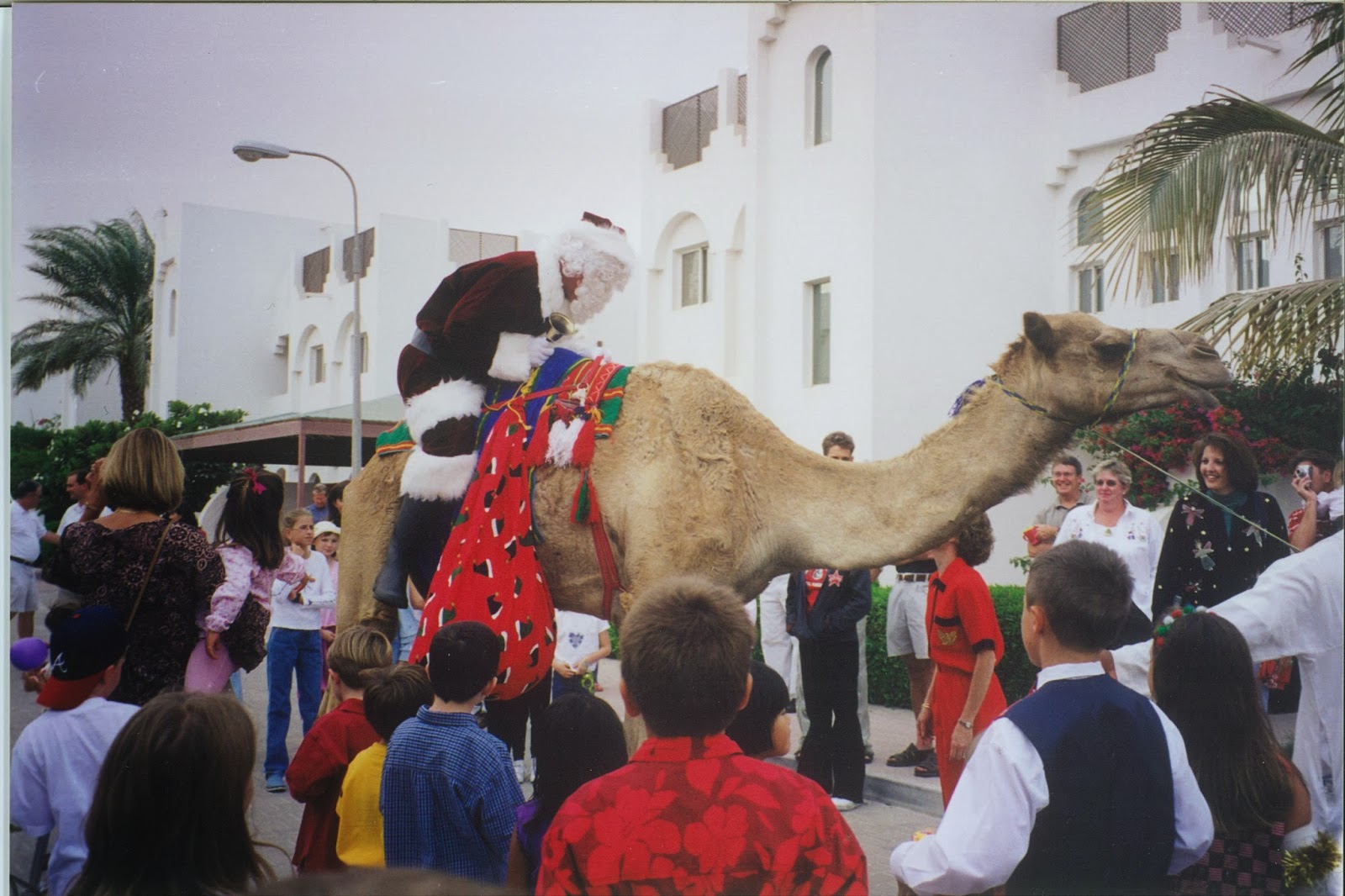
Santa is having a difficult time with his camel.

As you can see, Santa is having
a difficult time with his camel.
Sleds and reindeer are better.